 2
2
 0
0
Summary
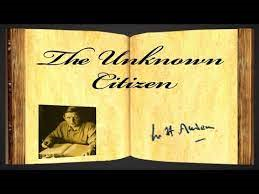
“The Unknown Citizen” is a poem written by W.H. Auden. This poem exposes the modern situation where a person loses his individual identity. The poem is a satire not on the citizen, but on the way in which the average man in the street is controlled by the bureaucracy and which ignores the need for a man to be free and happy. In this poem, Auden shows that human freedom is restricted in the so-called free capitalist states as well.
The Unknown Citizen has no name; he has only a number, to whom the monument has been built. There were no any complaints about him. All the reports showed that his conduct was good. He was a saint not due to he searched for God but because he served the government perfectly. He worked in a factory and never got fired. He satisfied his employers. His union reports showed that he paid all his dues. The social ‘psychology workers found that he was popular among his fellow workers and liked a drink. He also bought a newspaper every day. His reactions to advertisements were normal.
Similarly, he was fully insured. His health-card showed he was once in hospital but he came out after quite cured. He was fully sensible to the advantages of the installment plan. He had everything a modern man needed at home such as a phonograph, a radio, a car, a fridge. Moreover, when there was peace, he supported it. But when there was war, he was ready to fight. He was married and added five children to the population. He never interfered with to his teachers.
Finally, the poet asks the important questions. Was this man free? Was he happy? No government statistics can ever answer these kinds of questions. In the poem, the word ‘unknown’ means ordinary. Many ordinary citizens of the state spend their lives for defending their motherland. They want name and fame, but remain unknown. He has no individuality and identity. At the end of the poem, the poet is drawing our attention to the question of freedom and happiness by asking the questions. Ironically, this poem is a bitter attack on modern society-its indifference towards individuality and identity.
Questions:
1. Who is the “he” referred to in the poem?
Ans: He refers to the unknown citizen.
2. What is the basic problem exposed in this poem.
Ans: The basic problem exposed in the poem is that the citizens are controlled by the bureaucracy in such a way which ignores the need for a man to be free and happy. Many ordinary citizens of the state spend their lives for defending their motherland. They want name and fame, but remain unknown.
3. What is the modern sense of the word “saint”?
Ans: The modern sense of the word “saint” means any person who serves the government perfectly but not due to he searches for God.
4. The poem lists several items necessary to modern man. Does the list give you a clue to the date of the poem’s authorship?
Ans: The poem lists several items necessary to modern man such as concept of Fudge Motors INC, Research and High-Grade Living give us clue to the date of the poem’s authorship. High Grade Living was the name of insurance company of his time.
5.What is the meaning of the final line?
Ans: The meaning of the final line is to show gap of the freedom to the modern man in the industrial countries. At the end of the poem, the poet asks two questions. Was he free? Was he happy? No government statistics can ever answer these kinds of questions. By asking these questions, the poet is drawing our attention to the question of freedom and happiness. Ironically, the poet suggests that the modern man is slave to routine and he is incapable of understanding concepts of freedom and happiness.
6.Are the questions at the conclusion really “absurd”?
Ans: Ironically, the poet suggests that the modern man is slave to time and he is incapable of understanding ideas of freedom and happiness. Therefore, such a question in this context would be ‘absurd’. Thus, this poem is a bitter attack on modern society for its indifference towards individuality and identity. The only way for an individual to survive in a regimented society is to conform, obey and live in perpetual mental slavery.
7.What tendencies in our civilization does Auden satirize?
Ans:The poem is a satire of standardization at the expense of individualism. The poem is implicitly the work of a government agency at some point in the future when modern bureaucratizing trends have reached the point where citizens are known by arbitrary numbers and letters, not personal names.
8.This poem chronicles a life. How would it have to be changed to chronicle the life of a Nepali citizen? Make these changes in the poem.
Ans: It is chronicle poem in which modern man’s factual situation has been shown. In Nepal, many governmental job holders especially armies make great contribution to the nation. They forgetting their family members go to war and become martyr while fighting for the sake of nation. So, if they are killed, government should take responsibilities to support their family. If they are retired, government with giving much respect should provide them honourable job.
9.What do the concepts of freedom and happiness have to do with the person’s life? How? Why?
Ans: The word freedom refers to the possibility that every person has to make decisions regarding their own lives, yet with certain limitations. We have the ability to choose from a variety of options but in the same time, we must not endanger the freedom of others. Absolute freedom shouldnot exist.
Freedom of thought, opinion, creativity and faith are fundamental. human rights which are found in the constitutions of numerous acts of international significance. Freedom in this context is not physical, but a spiritual creation, belief, thought and free manifestation.
Freedom of expression is one of the most debated issues in the recent years. The conflicts between civilizations are centred on the issue of the right of individuals to express their views and opinions. It is obvious that when people are allowed to freely express their ideas, their opinions will be various. At that time, we must be able to guarantee the coexistence of those opinions. Freedom of expression does not require following the opinion of the people, but we must give everybody the right to expose their ideas. When you know that you can choose then you are free. Freedom of speech does not mean saying anything, but to know that you can afford to say anything.


Average Rating