 0
0
 0
0
About Socrates
Socrates was an ancient Greek philosopher whose way of life, character, and thought exerted a profound influence on Western philosophy. He was born in Athens, Greece. Socrates was a widely recognized and controversial figure in his native Athens, so much so that he was frequently mocked in the plays of comic dramatists. Although Socrates himself wrote nothing, he is depicted in conversation in compositions by a small circle of his admirers Plato and Xenophon first among them. He is portrayed in these works as a man of great insight, integrity, self-mastery, and argumentative skill. The impact of his life was all the greater because of the way in which it ended: at age 70. he was brought to trial on a charge of impiety (lack of piety) and sentenced to death by poisoning by a jury (judge) of his fellow citizens.
Summary
“The Allegory of the Cave” is taken from Book VII of Plato’s Republic. Plato was born into an aristocratic Athenian family. He eventually became a student of Socrates and later involved himself closely with Socrates’ work and teaching. Most of Plato’s works are philosophical essays, with Socrates as a character speaking in a dialogue with one or more students or listeners. We know what we perceive if we have no way of knowing anything beyond that. The contrast between knowledge and ignorance has important moral and political implications. The people who do not understand what is truly good for people, cannot live a good life. Likewise, the political ruler who does not understand what is good for society will bring misery to his people.
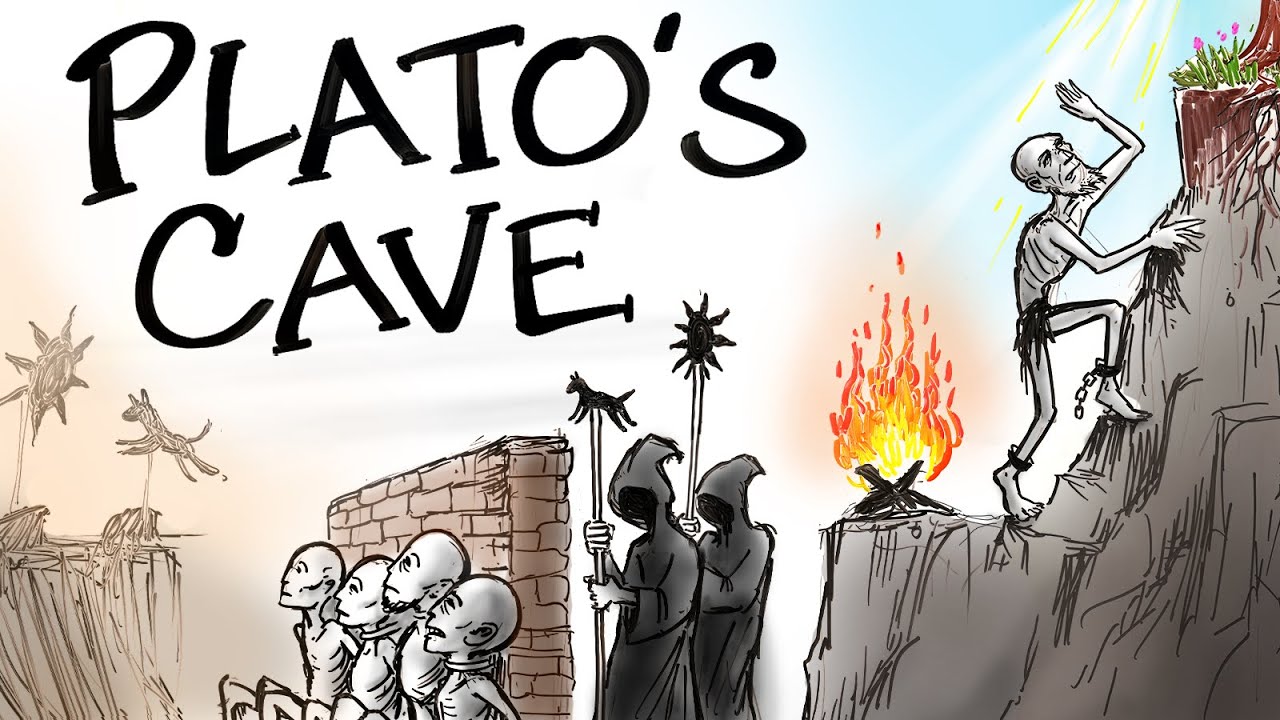
“The Allegory of the Cave” is an allegory presented by the Greek philosopher Plato in his work Republic to compare “the effect of education and the lack of it on our nature”. An allegory means a story, poem, or picture that can be interpreted to reveal a hidden meaning. It is written as a dialogue between Plato’s brother Glaucon and his adviser Socrates. Socrates describes that a group of people are in the cave who have their legs and necks chained so that they cannot move from their places or cannot see around them. They are just facing a blank wall. There is fire above and behind them and they can see only the shadows falling over the walls. The shadows are the prisoners’ reality, but are not accurate representations of the real world. Due to the long stay inside the cave, the people whatever they see on the wall is taken to be the truth. As they have been living with this condition for ages, they have no knowledge of the real world outside their cave. Thus, the images on the wall and the echo of various voices are the ultimate truth for them.
When any one of them is set free and dragged up to the mouth of the cave, he suffers sharp pains. First, his freed legs give him pain, and then the effort of climbing upward gives him pain. Then the daylight of the outside which is real world will dazzle his eyes. He has to habituate himself in the new surroundings and with new objects. When his eyes are habituated, he begins to see the real truth in real world. Then, he considers himself fortunate for having this opportunity to see the truth, and pities (feel sorrow) for his fellow prisoners who are still living in the cave which is dark ignorant world.
Plato continues, saying that when the freed prisoner shares his experience of outside with the other prisoners in the cave, they will also try to come into sunlight outside the cave. When he re-enters the cave, he will be blind because his eyes have become habituated to the sunlight. According to Plato, the prisoners would conclude from the returning man’s blindness that the journey out of the cave had harmed him and they should not accept a similar journey. Plato concludes that they would kill anyone who attempts them to send out of the cave.
Thus, according to Plato, the cave is the world of the senses, which prevents our upward journey to the world of reality. The upward journey is the rise of the soul into the intellectual world. The In Plato’s theory, the cave represents people who believe that knowledge comes from what we see and hear in the world. The cave shows that believers of observed knowledge are trapped in a ‘cave’ of misunderstanding. ‘The shadows’ represent the perceptions of those who believe observed knowledge. If you believe that what you see should be taken as truth, then you are only seeing a shadow of the truth. The escaped prisoner represents the Philosopher, who seeks knowledge outside of the cave and outside of the senses.
The Sun represents philosophical truth and knowledge His intellectual journey represents a philosophers journey when finding truth and wisdom. The other prisoners reaction about the escapee’s (a person who has escaped) returning represents that people are fearful knowing philosophical truths and do not trust philosophers.
Questions
1) What does the situation seem to be in this dialogue? What would you say is the relationship is between Socrates and Glaucon?
Ans: The situation seems to be in this dialogue is philosophical in which Glaucon asks and Socrates replies. The relationship between Socrates and Glaucon is guru and disciple.
2) Describe how the people in the cave are situated. Why can’t they move their legs or necks to take a look around? What is the only thing they are capable of seeing? What is their only source of light?
Ans: The people are in the cave. The cave is very dark because there is little light inside it and hardly seen the objects. Their legs and necks are chained so they can’t move their legs or necks to take a look around. They cannot move from their places or cannot see around them. They are just facing a blank wall. The only thing they are capable to see are shadows. Their only source of light is fire.
3) What do these prisoners trapped in the cavern believe is real?
Ans: The people inside the cave cannot raise their head completely. So they believe that their shadows are real.
4) How do the prisoners react when they first see sunlight?
Ans: If one of the chained prisoners is freed from the cave and he goes outside, his eyes dazzle seeing the Sun. He cannot see anything at first because his eyes dazzle in the light.



Average Rating